
March Market Momentum: The Most Common Fears About Buying a Home (And How to Navigate Them)
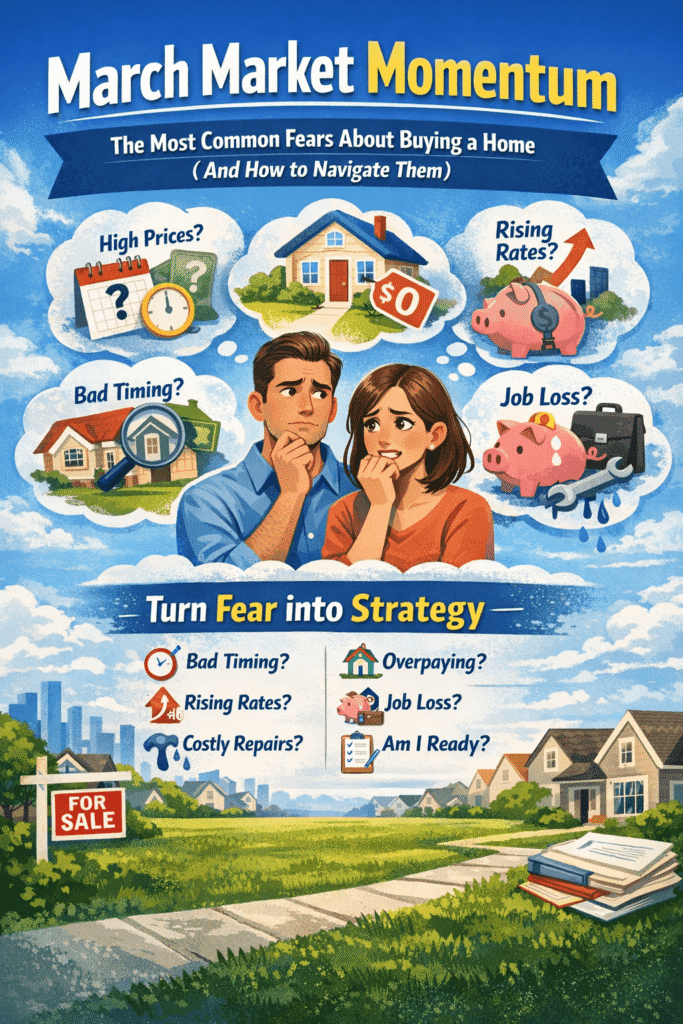
As we move through this month, many buyers are watching the market closely — rates, inventory, competition.
And while headlines tend to focus on economics, most purchase decisions are influenced by something much more personal:
Fear.
Whether you’re a first-time buyer or re-entering the market, hesitation is normal. The key is distinguishing between emotional noise and strategic risk.
Let’s break down the most common fears we’re hearing from buyers across the U.S. — and what they actually mean.
1. “What if I buy at the wrong time?”
This is the most frequent concern.
Buyers worry about:
- Interest rates dropping after they lock in
- Home values adjusting
- Timing the “perfect” moment
Here’s the reality: timing the market perfectly is nearly impossible. Real estate should be evaluated based on:
- Your financial stability
- Your long-term plans (3–7+ years)
- Affordability at today’s payment
- Refinance potential later
If the payment is comfortable and aligns with your goals, the “right time” is often when you are financially ready — not when the headlines say so.
2. “What if I’m overpaying?”
In competitive markets, buyers fear stretching too far.
A strategic approach prevents this:
- Analyze comparable sales, not listing prices
- Understand price per square foot trends
- Evaluate days on market
- Negotiate based on data, not emotion
Overpaying typically happens when buyers skip due diligence. With the right representation and data-driven analysis, you make informed offers — not impulsive ones.
3. “What if rates drop after I buy?”
Interest rate volatility creates hesitation.
Important perspective:
You can refinance a rate.
You cannot refinance the purchase price.
If you secure a home that meets your long-term needs at a price that works within your budget, refinancing later may improve your financial position. Waiting for rates to drop could mean facing higher home prices or increased competition.
The focus should be on payment sustainability — not rate perfection.
4. “What if I lose my job?”
Economic uncertainty drives this fear.
Before purchasing, assess:
- Emergency reserves (ideally 3–6 months of expenses)
- Industry stability
- Income diversity (dual income, side revenue, etc.)
- Monthly debt-to-income ratio
Buying should strengthen your financial position — not strain it. A properly structured mortgage should feel stable, not stressful.
5. “What if something major breaks?”
Maintenance anxiety is real — especially for first-time buyers transitioning from renting.
Mitigation strategies include:
- Thorough inspections
- Reviewing roof, HVAC, and major systems age
- Negotiating seller credits when appropriate
- Budgeting a home maintenance reserve
Ownership does include responsibility — but it also builds equity. Planning for maintenance is part of responsible asset management.
6. “What if I’m not ready?”
This is often less about finances and more about confidence.
Ask yourself:
- Is your income stable?
- Is your credit profile solid?
- Do you plan to stay in the area for several years?
- Is your rent comparable to (or close to) a mortgage payment?
If the fundamentals are aligned, hesitation may simply be fear of commitment — not actual unreadiness.
The Bigger Picture: Real Estate Is a Long-Term Strategy
Homeownership is not a short-term trade. It’s a long-term wealth-building tool.
Over time, buyers typically benefit from:
- Equity growth
- Payment stability (with fixed-rate financing)
- Tax advantages
- Protection against rent inflation
- Asset appreciation over multiple cycles
Short-term market shifts rarely define long-term outcomes.
Moving Forward This Month
If you’ve been considering a purchase, this month is an opportunity to move from uncertainty to clarity:
- Review your credit and debt structure
- Evaluate your purchasing power
- Analyze current local inventory
- Model monthly payment scenarios
- Get pre-approved to understand your real numbers
Fear is natural. Acting without data is optional.
The goal isn’t to eliminate uncertainty — it’s to make informed decisions within it.
If you want to evaluate your position strategically this month, the first step is understanding your numbers. From there, everything becomes clearer.